The only thing both sides agreed on during opening statements in the Karen Read murder trial on Tuesday was the chaotic scene on the morning of Jan. 29, 2022.
At about 6 a.m., Canton firefighter Timothy Nuttall opened the back door of his ambulance to see Read running frantically and screaming, snow whipping in his face and a body in the snow on that dark morning.
Special prosecutor Hank Brennan described the scene as “bedlam” when first responders found Read’s then-boyfriend, John O’Keefe, the man authorities say she killed by erratically driving her SUV backwards into him after an argument the night before.
Brennan gave jurors a detailed story during opening statements about what Nuttall saw that morning and his account of hearing Read say, “I hit him, I hit him, I hit him.” Read’s defense is highly skeptical of the statements since an initial police report did not include them.
The prosecutor gave an overview of the case and said that Read and O’Keefe were falling out in the weeks before his death, and that she drank eight drinks within three hours before she drove to a house party in Canton where his body was later found.
Brennan used several time stamps based on O’Keefe’s cell phone to give jurors a sense of how authorities say O’Keefe came to lie unconscious, and said that the prosecution’s case will rely heavily on O’Keefe’s cell phone’s GPS, health and battery data.
The battery data, new to this trial, will show how it steadily dropped in temperature while O’Keefe lay in the snow, according to Brennan.
Read’s retrial will give both sides a second shot at convincing jurors of their version of events.
Last July, Judge Beverly Cannone declared a mistrial after jurors could not agree on the three charges: second-degree murder, manslaughter while operating under the influence and leaving the scene of an accident causing injury or death in connection with O’Keefe’s death.
This time around, there’s a new prosecutor. Norfolk District Attorney Michael Morrissey tapped defense attorney Brennan to head the prosecution while the previous lead prosecutor, Adam Lally, remains on the sidelines.

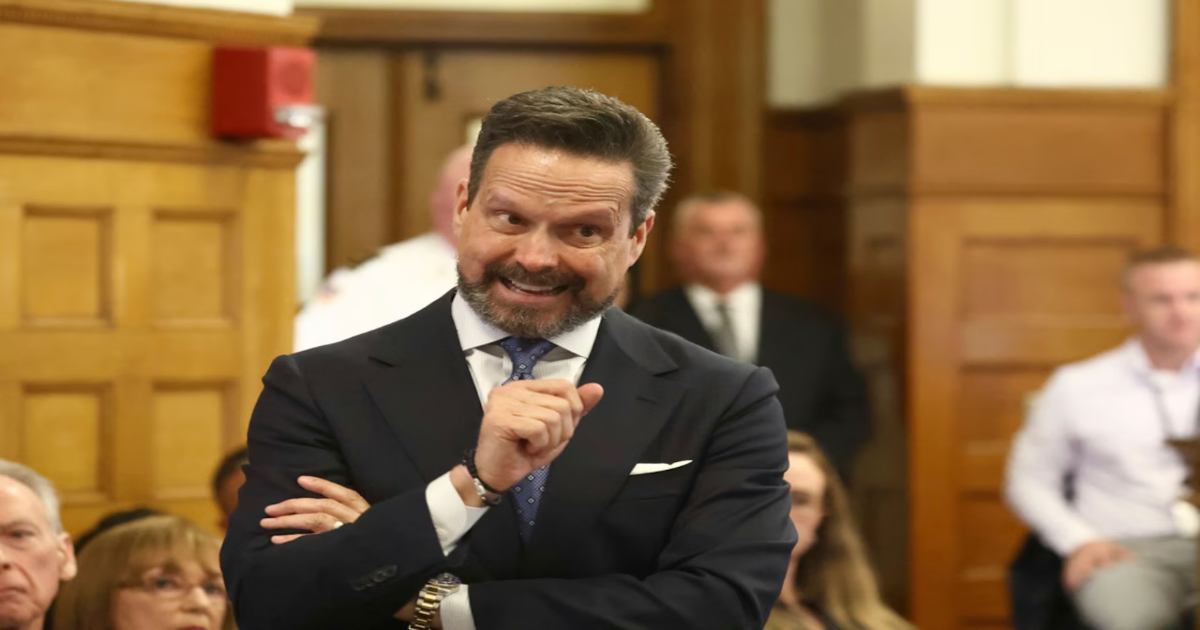
Special prosecutor Hank Brennan gives his opening argument at Karen Read’s second murder trial at Norfolk Superior Court on Tuesday, April 22, 2025 in Dedham, Mass. (Stuart Cahill /The Boston Herald via AP, Pool)AP
“Retrial tends to favor the prosecution as there is no element of surprise, and they are able to prep their witnesses a bit better,” Neama Rahmani, president of Los Angeles-based West Coast Trial Lawyers and a former federal prosecutor, said on Tuesday.
He said prosecutors “probably overcharged the first time with murder,” and noted that the jury at the first trial didn’t seem convinced. The prosecution leaned heavily on Read’s “I hit him” statements last year, and Rahmani said using her own words is “very powerful.”
On Tuesday, Brennan brought a storytelling element to the opening and gave plenty of time stamps for jurors to understand their theory of the case.
He described how authorities say Read killed O’Keefe. She drove 35 feet forward before stopping, putting the car in reverse, and slamming down on the gas pedal before clipping O’Keefe, according to Brennan.
He fell backward, hit his head and broke his skull, Brennan said, with Read aware she’d hit O’Keefe.
At the first trial, Lally gave jurors more context about Read and O’Keefe’s relationship and said it soured in the weeks leading up to his death. On Tuesday, there was no mention of an Aruba trip in 2022 where Read screamed at another woman, a friend of O’Keefe’s, and accused him of kissing her.
“It’s probably smart not to hit on motive as the No. 1 theme of the prosecution,” criminal defense attorney Sam Bassett, who’s followed the trial from Austin, Texas, said. “I didn’t see him (Brennan) as a highly emotional presenter. He’s more methodical and emphasized the data points that are going to support the overall story.”
“With both sides, emphasizing motive for their theory of the case, or overemphasis, is dangerous. You want to let the jury come to that conclusion of motive based on the evidence, you don’t want to jam that down their throat,” Bassett said.
Alan Jackson, Read’s lawyer, altered the defense’s approach to the opening from last year.
From the jump at the first trial, Read’s lawyers claimed she’d been “framed” and that a law enforcement conspiracy had pinned a murder charge on her.
Jackson instead focused much of his arguments on Tuesday morning on the “extreme reasonable doubt” that exists in the case.
“The lawyers have a lot more information now than they did in the first trial,” Bassett said. “They can, and did, rethink their strategy and arguments and they obviously have, to a more data-based presentation, certainly in the openings.”
Read’s lawyers have contended for years that her SUV never struck O’Keefe. The last witnesses from the first trial were from an accident reconstruction company called ARCCA, and they are expected to testify once again that Read’s SUV did not have damage consistent with hitting a pedestrian.
They also testified that O’Keefe did not have injuries consistent with being struck by a vehicle, such as having broken bones or bruises to the torso.
“Medically and scientifically, he could not have been struck by a vehicle,” Jackson told jurors on Tuesday. “There was no collision.”
Jackson then laid the groundwork for where their theory of the case is headed as they use a third-party culprit defense where they will lay the blame on others who could’ve killed O’Keefe. He told jurors about a Google search by another witness at 2:27 a.m. of “ho(w) long to die in cold.”
He described phone calls between two other witnesses, homeowner Brian Albert and Brian Higgins, another law enforcement agent, at 2:22 a.m. He said witnesses destroyed their cell phones, and that the long-time family home of the Alberts was sold months later.
He said the family dog was “rehomed” after O’Keefe’s death — a point the defense emphasizes since they have an expert witness who says cuts on O’Keefe’s arm are consistent with being attacked by a dog.
Then, there’s the biggest difference from the first trial. Michael Proctor, the lead investigator of the case, was fired by the Massachusetts State Police earlier this year.
The embattled trooper fell from grace after text message were read during his testimony last year and revealed he’d used crude language to describe Read. He called her a “whack job (expletive),” “retarded” and even joked to his superiors about looking for nudes in her phone.
The text messages were also referenced by Jackson during openings on Tuesday to give jurors reason to believe the investigation was biased from the start. A high school friend had asked if the homeowner where O’Keefe was found would catch grief, and Proctor replied, “Nope, homeowner is a Boston cop, too.”
State police fired Proctor as a direct consequence of his actions in the Read case, a point Jackson emphasized for jurors.
“Probably worst law enforcement witness I’ve ever seen,” Rahmani said. “Either him or Mark Furhman in the OJ case.”
“Sometimes the best defense is a good offense, and if you can put law enforcement on trial and say, ‘They’ve done a poor job,’ that’s better,” Rahmani said. “There are some self-inflicted wounds by investigators in the case.”
Read, 45, is out on bail during her retrial. Testimony continues on Wednesday.