Tesla CEO Elon Musk has a lot riding in Austin — and as he puts it, the future of global transportation will emanate from here.
Tesla Inc. reported April 22 that work is continuing on a “cybercab” manufacturing line at its Travis County factory that will achieve volume production next year, even as it reported a steep drop in first-quarter financial results amid stiffening competition in the electric vehicle market, tariff uncertainty and a backlash against its lightning rod of a CEO.
The Austin-based company also reiterated plans for a pilot launch of its robotaxi ride-hailing platform in Austin by June, and it said efforts remain on track to begin production of “more affordable models” of its electric vehicles during the first half this year — meaning by July. The Travis County factory could play a key role in that effort because the lower-cost vehicles “will be produced on the same manufacturing lines as our current vehicle lineup,” the company said.
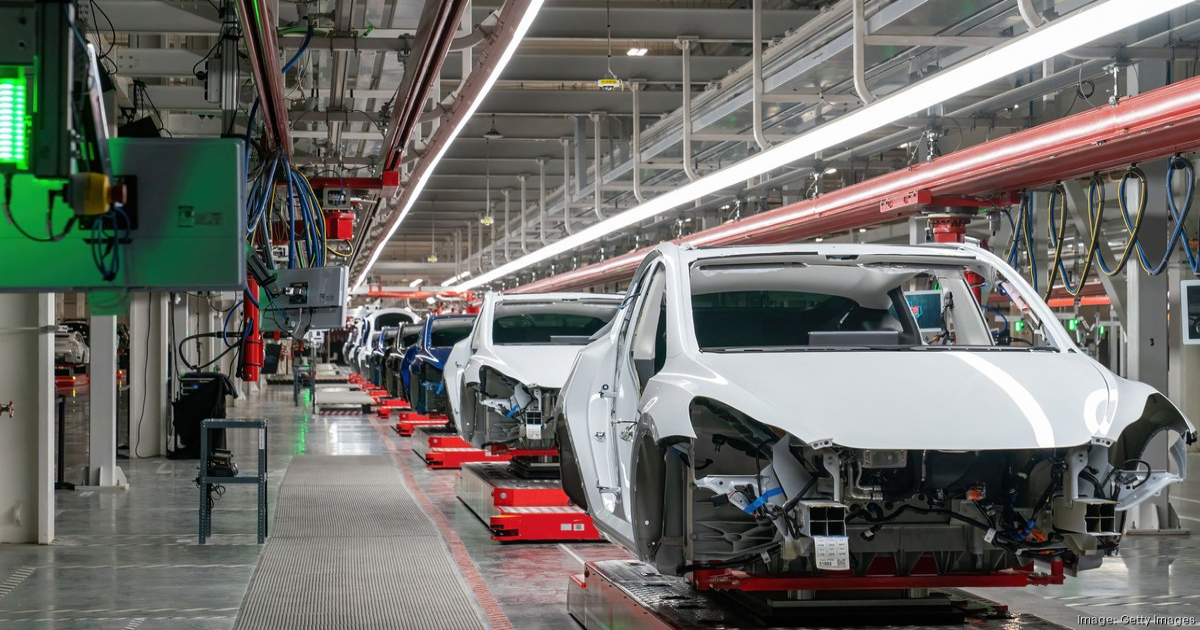
“The factory is the product as much as the product,” he said of the Texas gigafactory, adding that it can make autonomous vehicles cheaper and faster than competitors such as Waymo.
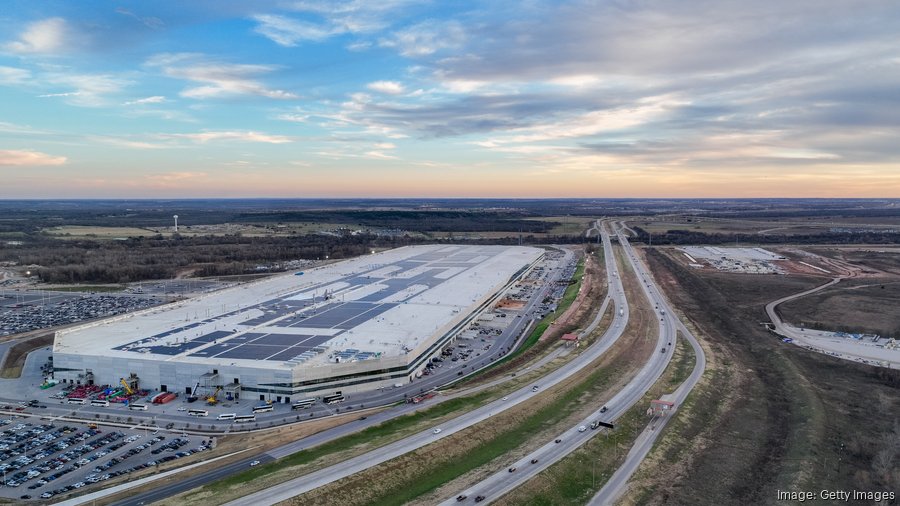
The Tesla plant east of Austin — which is both the company’s corporate headquarters and a massive electric vehicle plant — is seen in 2023 in Travis County.
Brandon Bell / Getty Images
Those plans could reassure some investors who have been impatient for Elon Musk-led Tesla to make cheaper vehicles and to show progress on robotaxis.
During a conference call with Wall Street analysts, Musk made another announcement that also has the potential to boost what has been flagging confidence in the company — saying he intends to reduce his work in the administration of President Donald Trump to “a day or two per week” beginning in May. Musk, the richest man in the world, is the head of Trump’s federal cost-cutting entity called the Department of Government Efficiency, which has generated substantial controversy and fueled numerous protests across the country.
Still, Musk dismissed opponents of DOGE during his comments to analysts, calling the protests “natural blowback” by “those involved with waste and fraud.” He called his work at DOGE critical to the country and company and said that despite scaling back, he’ll likely remain involved in federal government oversight in some capacity during the remainder of Trump’s term.
He said he’ll “spend a day or two per week on government matters for as long as the president would like me to do so and as long as it is useful.”
Musk also said that, regardless of “bumps in the road,” he’s optimistic that “excellent execution” will see Tesla become “by far” the most valuable company in the world in the future. Shares of Tesla, which has been struggling with slowing sales and production issues, have slumped roughly 40% so far in 2025.
In the first quarter, Tesla reported that its automotive revenue fell 20%, to $13.9 billion from about $17.4 billion in the year-ago period.
The company reported adjusted first-quarter earnings of 27 cents a share on total revenue of $19,3 billion — well below Wall Street’s consensus expectation of 41 cents a share on $21.1 billion in revenue. In the year-ago first quarter, the company reported adjusted earnings of 45 cents a share on $21.3 billion in total revenue.
Some analysts have been voicing increasing levels of concern about Musk’s work in the Trump administration and the time away from Tesla that it has required.
“Musk needs to leave the government, take a major step back on DOGE, and get back to being CEO of Tesla full-time,” Wedbush Securities analyst Dan Ives wrote in a note to investors prior to Tesla’s April 22 earnings report, describing it as a “Code Red Situation” for the company.
The List: Austin’s manufacturing heavyweights get bigger
On the conference call at least, Musk sounded like a CEO deeply involved in his company — although he started the call discussing DOGE. He said autonomy and artificial intelligence are differentiators for it, forecasting that by the end of this year, “thousands” of Tesla’s Optimus robots will be working in its factories.
Musk also noted that Tesla vehicles could in theory be used as robotaxis because of their autonomous capabilities, but cybercabs will be purpose-built vehicles without steering wheels or pedals.
“The vast majority of the Tesla fleet that we have made is capable of being a robotaxi, or a robotic taxi,” he said.
As for tariffs, Musk said he has used his direct line to Trump to advocate for them to be lower. But it’s “entirely up to the president of the United States,” he said. “I will continue to advocate for lower tariffs rather than higher tariffs — that’s all I can do.”
The Austin metro has plenty riding on Tesla. The company remains the region’s top tech employer despite its large layoffs last year, and it’s the second-largest private-sector employer behind only grocery giant H-E-B. Tesla finished last year with 21,191 employees in the metro, down about 7% from the 22,777 people it said it employed at the end of 2023 after enacting large layoffs in April 2024.